One thing I keep coming back to is who gets included in the research behind them.
Because that may affect more than inclusion. It may also affect the models we build of perception itself.
If we want to understand how people experience multiple senses together, there’s real value in studying people whose sensory experiences don’t fit the assumptions a design was built around.
They can make the structure of an experience easier to see.
A blind participant navigating through sound, touch, memory and spatial information can show how environmental understanding is built without relying on vision.
An autistic participant experiencing layered sound, movement and visual information differently can show where sensory richness supports understanding, and where it starts to create interference.
A person with low vision combining contrast, proximity, sound and learned cues can show how information gets pieced together across channels.
This is where accessibility research becomes especially interesting to me.
It doesn’t just identify barriers. It can reveal the architecture of an experience.
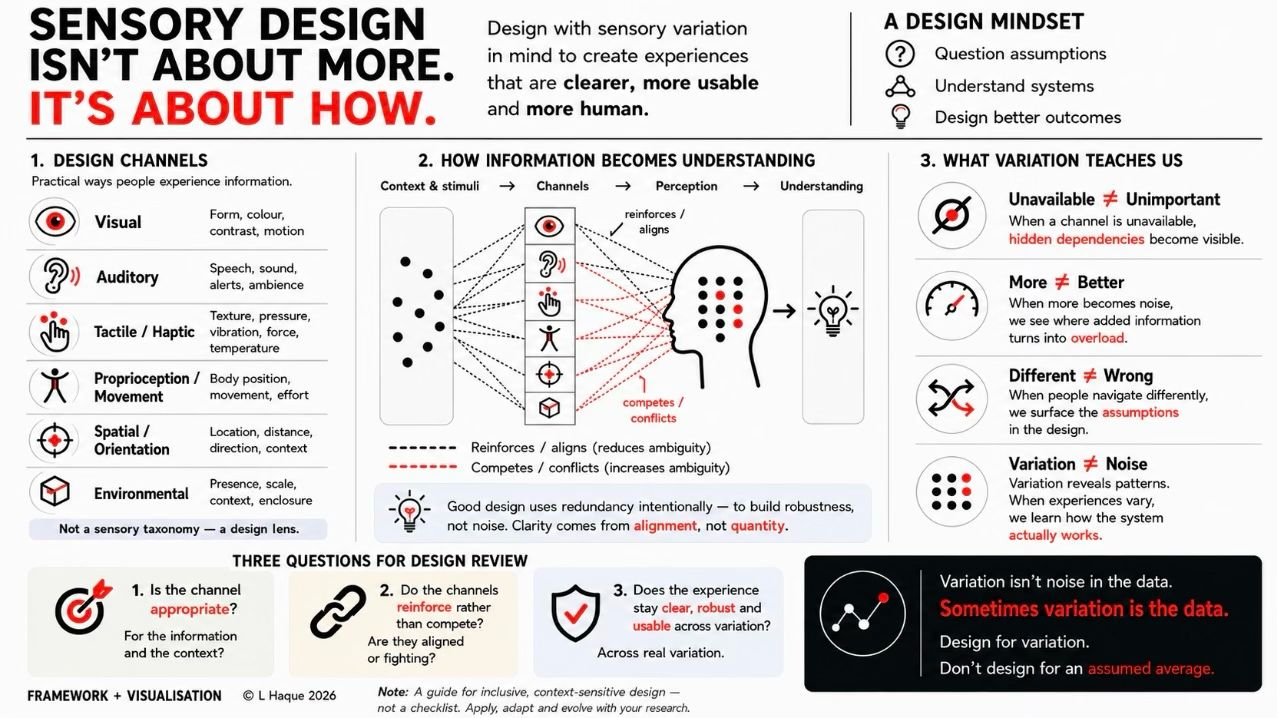
Which information is carrying the most weight? Which channels reinforce each other? Which compete? What happens when one becomes unavailable, unreliable or overwhelming?
Multisensory design is often associated with richness.
But richness isn’t the same as quantity.
More sound can become noise. More movement can become distraction. More haptics can become interruption. More sensory information can mean less usable information.
The more useful question isn’t how many channels are present. It’s how they work together.
Tightly defined participant groups can answer important questions. Broader sensory variation can reveal different things: hidden dependencies, redundant cues, conflicting signals and assumptions that were otherwise hard to see.
I’ve been developing a framework around this, looking at design channels, how they reinforce or compete with each other, and what variation can reveal about the assumptions built into an experience. I think that has implications for product design, emerging interfaces and any technology that asks people to interpret multiple signals at once.
Accessibility has taught me something useful:
Variation isn’t always noise in the data. Sometimes variation is the data.
A participant who experiences an environment differently isn’t necessarily an edge case in the research.
Sometimes they’re the person who makes the model visible.
InclusiveDesign, Accessibility, UXResearch, HumanFactors, MultisensoryDesign